Review Conceptual Example 7 Before Starting This Problem
Developing a Conceptual Framework for Research
A conceptual framework illustrates what you wait to find through your research. It defines the relevant variables for your report and maps out how they might chronicle to each other.
Yous should construct a conceptual framework before you brainstorm collecting information. It is frequently represented in a visual format.
This article explains how to construct a conceptual framework for an expected cause-and-consequence relationship, incorporating relevant variables that might influence that relationship.
What is a conceptual framework?
A conceptual framework is a written or visual representation of an expected relationship between variables. Variables are just the characteristics or properties that you lot desire to written report.
The conceptual framework is generally adult based on a literature review of existing studies and theories well-nigh the topic.
Before you outset collecting data, construct a conceptual framework to show exactly which variables you will measure and how y'all expect them to relate to each other.
A conceptual framework can be designed in many different means. The form yours takes will depend on what kinds of relationships you expect to notice.
Independent and dependent variables
If nosotros want to test a cause-and-issue relationship, nosotros need to place at least two key variables: the independent variable and the dependent variable. In our instance:
- the expected cause, "hours of written report," is the independent variable (aka the predictor or explanatory variable).
- the expected effect, "test score," is the dependent variable (aka the response or effect variable).
In other words, "exam score" depends on "hours of study." Our hypothesis is that the more hours a student studies, the improve they will do on the exam.
Causal relationships often involve several contained variables that affect the dependent variable. All the same, to keep things simple, nosotros'll work with just one contained variable, namely "hours of study."
To visualize our expected cause-and-event relationship, we will use the basic design components of boxes and arrows. Each variable appears in a box. To signal a causal relationship, each arrow should start from the independent variable (the cause) and point to the dependent variable (the effect).
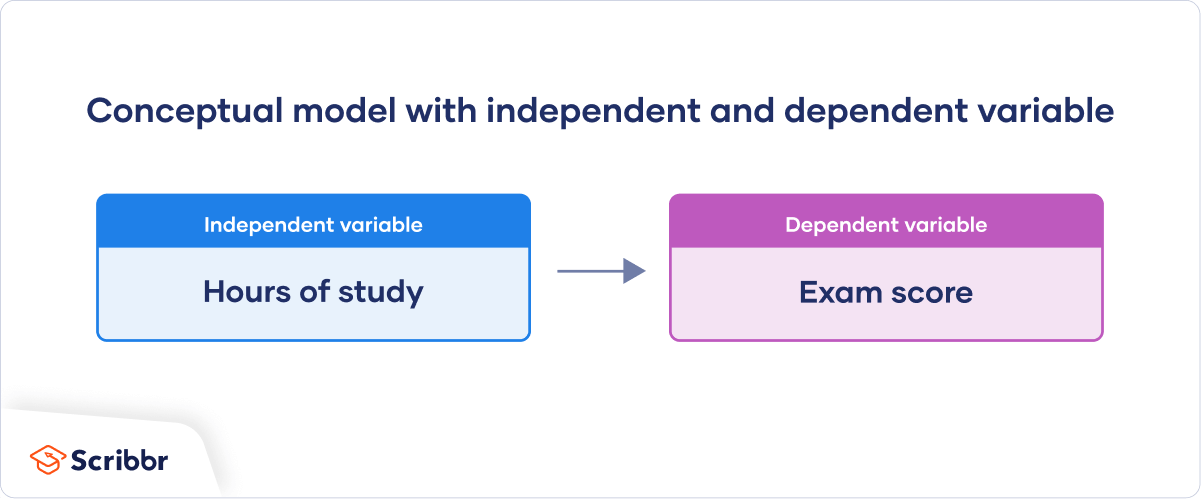
Next, we should identify other variables that might influence the relationship between our independent and dependent variables. Some common variables to include are moderators, mediators, and control variables.
Moderating variables
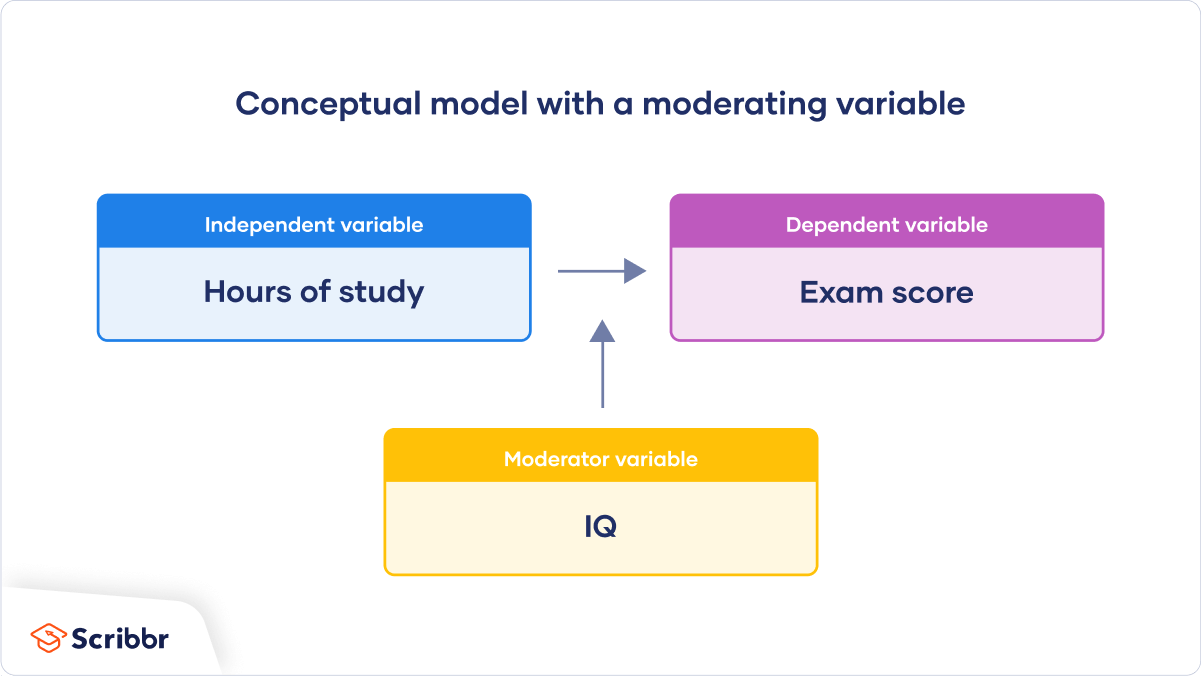
Now nosotros'll aggrandize the framework past adding a moderating variable (aka a moderator). A moderator alters the effect that an contained variable has on a dependent variable.
The moderator thus changes the effect component of the cause-and-effect relationship. This moderation is also referred to as the interaction upshot.
In our instance, we wait that the number of hours a pupil studies is related to their test score: the more than you fix, the higher your score will exist.
Now we add the moderator "IQ." A student's IQ level changes the issue that the variable "hours of study" has on the exam score: the higher your IQ, the fewer hours of report you lot must put in to do well on the exam.
In other words, the "IQ" moderator moderates the effect that the number of study hours has on the exam score.
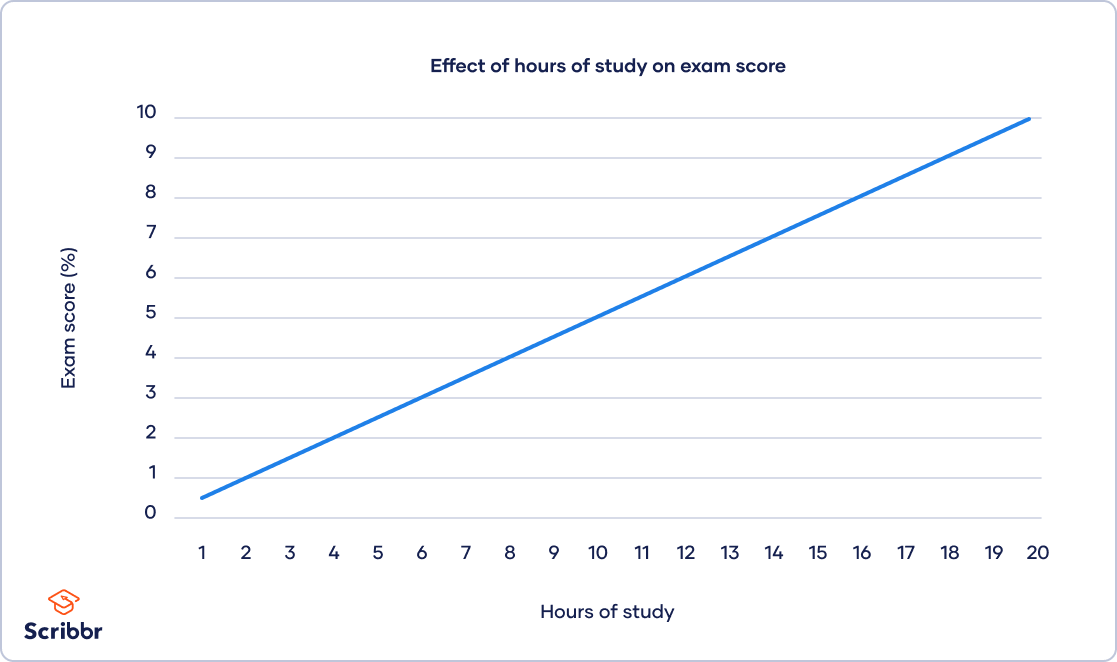
Permit's take a look at how this might work. The graph shows how the number of hours spent studying affects examination score. The more hours you study, the better your results. A student who studies for 20 hours will get a perfect score.
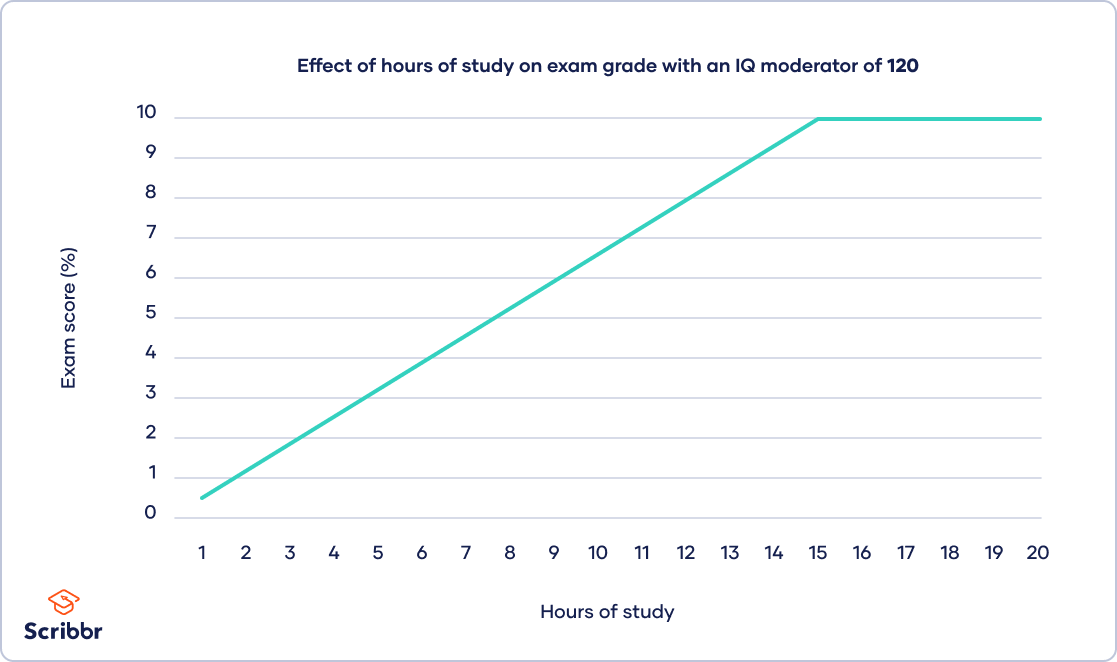
But the graph looks unlike when we add an "IQ" moderator of 120. A student with this IQ will already achieve a perfect score subsequently just fifteen hours of study.
Below, the value of the "IQ" moderator has been increased to 150. A pupil with this IQ will just need to invest 5 hours of studying in order to get a perfect score.
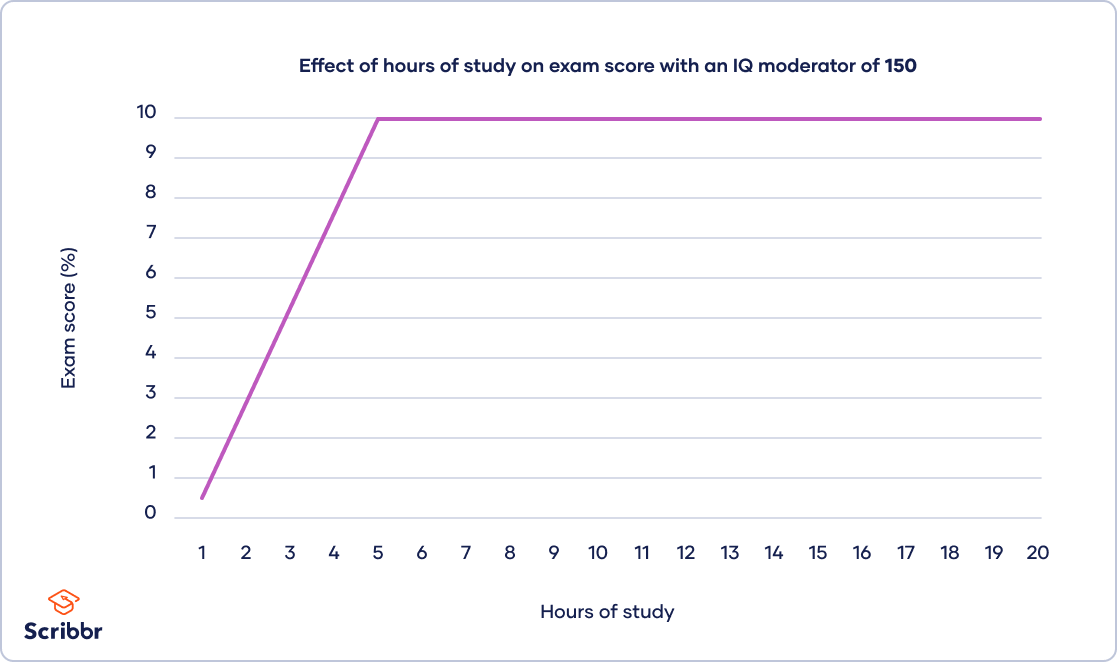
The higher the IQ, the fewer hours a student needs to study in order to attain a score of 100%.
In brusk, a moderating variable is something that changes the crusade-and-event relationship between two variables as its value increases or decreases.
Now we'll expand the framework by adding a mediating variable. In a cause-and-effect relationship, a mediating variable is a variable that links the independent and dependent variables, allowing the relationship between them to be meliorate explained.
Hither's how the conceptual framework might wait if a mediator variable were involved:
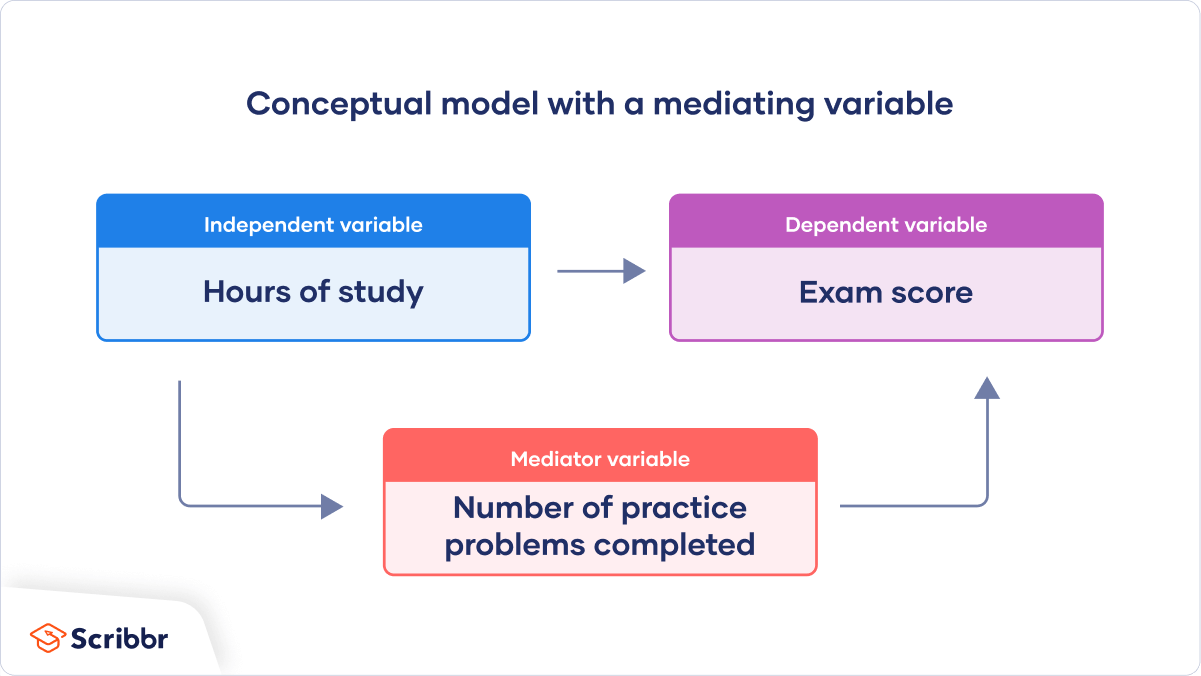
The mediating variable of "number of practice problems completed" comes betwixt the independent and dependent variables. The hours of written report impacts the number of practice issues, which in plow impacts the exam score.
In this case, the mediator helps explicate why studying more hours leads to a higher exam score. The more hours a student studies, the more practice issues they volition complete; the more practice issues completed, the college the student'south examination score will be.
By calculation the mediating variable of "number of practice problems completed," we help explain the cause-and-result relationship between the 2 chief variables.
Go on in heed that mediating variables can be difficult to interpret, and intendance must be taken when conclusions are drawn from them.
It's important not to misfile a moderators and mediators. To recall the difference, you can think of them in relation to the independent variable.
A mediating variable is affected by the independent variable, and it affects the dependent variable. Therefore, it links the ii variables and helps explain the relationship betwixt them.
A moderating variable isnot affected by the contained variable, even though affects the dependent variable. For instance, no matter how many hours you written report (the independent variable), your IQ will not go college.
Control variables
To examination a cause-and-effect relationship, we also need to consider other variables that nosotros're not interested in measuring the effects of, simply that could potentially bear upon students' exam scores.
These are command variables—variables that are held constant so that they don't interfere with the results.
For example, it is likely that if a student feels sick, they will become a lower score on the test. Therefore, nosotros'll add "health" as a control variable.
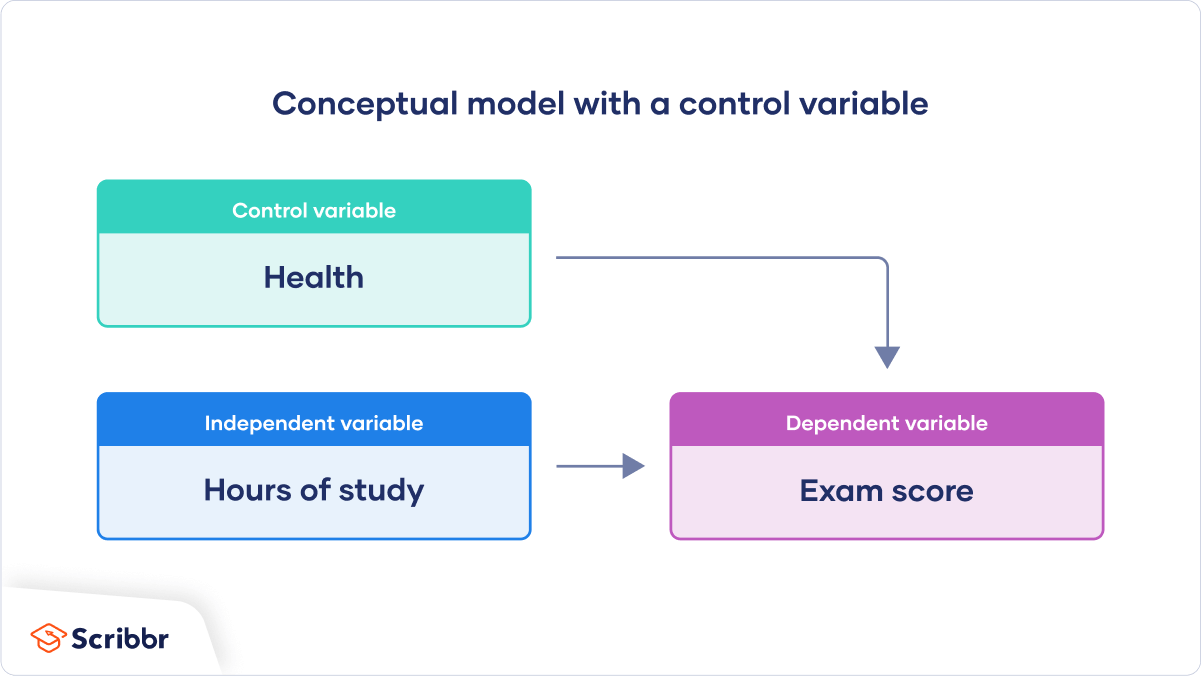
That means we should go on the variable "health" constant in our study—we'll but include participants who are in skillful health on the twenty-four hour period of the exam.
Is this article helpful?
Y'all have already voted. Thanks :-) Your vote is saved :-) Processing your vote...
Source: https://www.scribbr.com/methodology/conceptual-framework/
0 Response to "Review Conceptual Example 7 Before Starting This Problem"
Post a Comment