what kind of cases go to district court
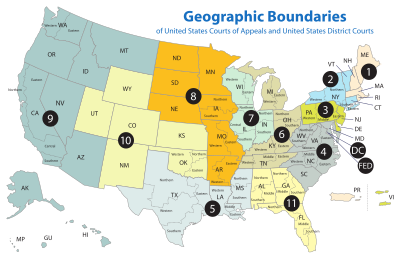
Map of the boundaries of the United States district courts inside each of the 13 circuits of the The states courts of appeals. All district courts lie within the purlieus of a single jurisdiction, usually in a state (heavier lines). Some states have more than one district court (dotted lines denote those jurisdictions)
The United States commune courts are the trial courts of the U.Southward. federal judiciary. Each federal judicial district has at to the lowest degree one courthouse, and many districts accept more than one. Virtually decisions of district courts may be appealed to the respective court of appeals of their circuit, with a pocket-size number instead being appealable to the Federal Circuit, or direct to the Supreme Court.
Commune courts are courts of law, equity, and admiralty, and can hear both civil and criminal cases. Just unlike U.Due south. state courts, federal district courts are courts of limited jurisdiction, and can only hear cases that involve disputes between residents of different states, questions of federal law, or federal crimes.
Dissimilar the U.S. Supreme Court, which was established by Article III of the Constitution, the district courts were established by Congress[note 1] under the Judiciary Act of 1789. There is no ramble requirement that district courts exist at all. Indeed, after the ratification of the Constitution, some opponents of a strong federal judiciary urged that, outside jurisdictions under direct federal control, like Washington, D.C., and the territories, the federal court system be limited to the Supreme Court, which would hear appeals from state courts.[ commendation needed ] All the same, this view did not prevail, and the first Congress created the district court arrangement that is still in place today. When the Human action was first passed, there were 13 districts created among the xi states which had ratified the constitution by that point. When North Carolina and Rhode Island voted to ratify, a district was created for each of them bringing the number of districts to xv.
In that location are 89 districts in the fifty states, with a total of 94 districts including territories.[one] There is at least one judicial commune for each land, the District of Columbia, and Puerto Rico. The territories (insular areas) of Guam, the Northern Mariana Islands, and the United States Virgin Islands each accept one territorial courtroom; these courts are chosen "district courts" and exercise the same jurisdiction as district courts,[2] [3] just differ from district courts in that territorial courts are Commodity IV courts, with judges who serve ten-year terms rather than the lifetime tenure of judges of Article III courts, such as the district court judges.[3] American Samoa does non take a commune court or a federal territorial court, and so federal matters there are sent to either the Commune of Columbia or Hawaii.[iv]
Other federal trial courts [edit]
In that location are other federal trial courts that have nationwide jurisdiction over certain types of cases, but the commune court also has concurrent jurisdiction over many of those cases, and the district court is the only i with jurisdiction over civilian criminal cases.
The United States Court of International Merchandise addresses cases involving international trade and customs issues. The United States Courtroom of Federal Claims has exclusive jurisdiction over most claims for money damages against the United states of america, including disputes over federal contracts, unlawful takings of private belongings past the federal government, and suits for injury on federal property or by a federal employee. The United States Tax Courtroom has jurisdiction over contested pre-assessment determinations of taxes.
Judges [edit]
A approximate of a United States district courtroom is officially titled a "United States District Estimate". Other federal judges, including excursion judges and Supreme Court justices, can as well sit in a commune court upon assignment past the master judge of the circuit or by the Chief Justice of the United states of america. The number of judges in each district courtroom (and the structure of the judicial organization generally) is set by Congress in the U.s. Code. The President appoints the federal judges for terms of expert behavior (subject to the communication and consent of the Senate), so the nominees often share at to the lowest degree some of his or her convictions. In states represented by a senator of the president's party, the senator (or the more than senior of them if both senators are of the president'southward party) has substantial input into the nominating process, and through a tradition known as senatorial courtesy can exercise an unofficial veto over a nominee unacceptable to the senator.
With the exception of the territorial courts (Guam, the Northern Mariana Islands, and the Virgin Islands), federal commune judges are Article III judges appointed for life, and can be removed involuntarily just when they violate the standard of "practiced behavior". The sole method of involuntary removal of a gauge is through impeachment by the U.s.a. House of Representatives followed past a trial in the United States Senate and a conviction past a two-thirds vote. Otherwise, a judge, fifty-fifty if convicted of a felony criminal law-breaking by a jury, is entitled to hold office until retirement or death. In the history of the U.s.a., simply twelve judges have been impeached past the House, and only seven have been removed following conviction in the Senate. (For a table that includes the twelve impeached judges, see Impeachment in the U.s..)
A gauge who has reached the age of 65 (or has go disabled) may retire or elect to go on senior status and keep working. Such senior judges are not counted in the quota of agile judges for the commune and do only whatever piece of work they are assigned by the chief judge of the district, but they proceed their offices (chosen "chambers") and staff, and many of them work full-time. A federal judge is addressed in writing equally "The Honorable John/Jane Doe" or "Hon. John/Jane Doe" and in speech as "Judge" or "Approximate Doe" or, when presiding in court, "Your Honor".
District judges usually concentrate on managing their court's overall caseload, supervising trials, and writing opinions in response to important motions like the motion for summary judgment. Since the 1960s, routine tasks like resolving discovery disputes can, in the district judge's discretion, be referred to magistrate judges. Magistrate judges tin also exist requested to prepare reports and recommendations on contested matters for the district judge'due south consideration or, with the consent of all parties, to presume complete jurisdiction over a case including conducting the trial.
Federal magistrate judges are appointed by each district court pursuant to statute. They are appointed for an eight-year term and may be reappointed for additional eight-twelvemonth terms. A magistrate guess may be removed "for incompetency, misconduct, neglect of duty, or physical or mental inability".[5] A magistrate judgeship may be a stepping stone to a commune judgeship nomination.
As of 2010, in that location were 678 authorized district court judgeships.[six]
Clerks [edit]
Each commune court appoints a clerk, who is responsible for overseeing filings made with the court, maintaining the courtroom's records, processing fees, fines, and restitution, and managing the non-judicial work of the court, including information technology, upkeep, procurement, homo resources, and financial. Clerks may appoint deputies, clerical assistants, and employees to acquit out the piece of work of the courtroom. The clerk of each district court must reside in the district for which the clerk is appointed, except that the clerk of the District of Columbia and the clerk of the Southern Commune of New York may reside within 20 miles of their respective districts.
The Judiciary Act of 1789 authorized the Supreme Court and the guess of each U.S. District Court to appoint a clerk to assist with the assistants of federal judicial business in those courts. The clerk for each district court was to also serve as clerk of the corresponding circuit court. The Judiciary Human activity required each clerk to issue the writs summoning jurors and "to record the decrees, judgments and determinations of the court of which he is clerk."
The Judicial Lawmaking (28 U.Southward.C. § 751) provides that the clerk is appointed, and may exist removed, by the court. The clerk's duties are prescribed by the statute, past the court's customs and practices, and past policy established by the Judicial Briefing of the U.s.. The clerk is appointed past social club of the court en banc to serve the entire courtroom. The function of the clerk and deputies or administration should non be dislocated with the judges' law clerks, who assist the judges by conducting inquiry and preparing drafts of opinions.
To be eligible to serve equally a clerk, a person must take a minimum of 10 years of progressively responsible authoritative experience in public service or business that provides a thorough understanding of organizational, procedural, and man aspects of managing an organization, and at to the lowest degree three of the x years must accept been in a position of substantial management responsibleness. An attorney may substitute the active do of law on a year-for-year basis for the direction or administrative experience requirement. Clerks do non have to be licensed attorneys, but some courts specify that a law degree is a preference for employment.
Jurisdiction [edit]
Dissimilar some country courts, the power of federal courts to hear cases and controversies is strictly limited. Federal courts may not decide every case that happens to come earlier them. In society for a commune court to entertain a lawsuit, Congress must first grant the court subject matter jurisdiction over the type of dispute in question.
The commune courts exercise original jurisdiction over—that is, they are empowered to conduct trials in—the following types of cases:
- Civil actions arising under the Constitution, laws, and treaties of the United States;[7]
- Sure ceremonious deportment between citizens of different states or citizens of a land and a strange land;[8]
- Civil actions within the admiralty or maritime jurisdiction of the United States;[9]
- Criminal prosecutions brought by the United States;[x]
- Civil deportment in which the Us is a party;[11] and
- Many other types of cases and controversies[12]
For most of these cases, the jurisdiction of the federal commune courts is concurrent with that of the country courts. In other words, a plaintiff tin can choose to bring these cases in either a federal district court or a land courtroom. Congress has established a procedure whereby a political party, typically the defendant, tin can "remove" a instance from state court to federal court, provided that the federal court as well has original jurisdiction over the matter (pregnant that the case could accept been filed in federal court initially).[13] If the political party that initially filed the case in state court believes that removal was improper, that party can ask the district courtroom to "remand" the case to the land court system. For sure matters, such as patent and copyright infringement disputes and prosecutions for federal crimes, the jurisdiction of the district courts is exclusive of that of the country courts, meaning that only federal courts can hear those cases.[notation 2]
In improver to their original jurisdiction, the commune courts have appellate jurisdiction over a very express grade of judgments, orders, and decrees.[14]
Attorneys [edit]

United States District Courtroom Attorney Admissions Reciprocity Map
In gild to stand for a party in a case in a district court, a person must be an attorney at police force and more often than not must be admitted to the bar of that item courtroom. The United States usually does not have a separate bar examination for federal practice (except with respect to patent practice before the U.s. Patent and Trademark Office). Admission to the bar of a district court is by and large bachelor to any chaser who is admitted to practice law in the country where the district court sits.[notation 3]
56 districts (effectually 60% of all district courts) require an attorney to be admitted to do in the land where the commune court sits. The other 39 districts (around 40% of all district courts) extend admission to sure lawyers admitted in other states, although conditions vary from court to court. For example, the district courts in New York City (Southern Commune of New York and Eastern Commune of New York) extend admission to attorneys admitted to the bar in Connecticut or Vermont and to the district court in that land, but otherwise require attorneys to be admitted to the New York bar. Only thirteen districts extend access to attorneys admitted to any U.S. land bar.[15] [16]
The attorney mostly submits an application with a fee and takes the adjuration of admission. Local practise varies every bit to whether the adjuration is given in writing or in open court before a judge of the district. A "sponsor" admitted to the court's bar is often required. Several district courts require attorneys seeking admission to their confined to have an additional bar examination on federal law, including the post-obit: the Southern District of Ohio,[17] the Northern District of Florida,[18] and the District of Puerto Rico.[19]
Pro hac vice admission is also available in almost federal commune courts on a case-by-instance basis. Nigh district courts crave pro hac vice attorneys to associate with an attorney admitted to practice before the court.[fifteen]
Appeals [edit]
Generally, a last ruling by a district court in either a civil or a criminal case can be appealed to the United States courtroom of appeals in the federal judicial circuit in which the district court is located, except that some district court rulings involving patents and certain other specialized matters must be appealed instead to the United States Court of Appeals for the Federal Circuit, and in a very few cases the appeal may be taken straight to the United States Supreme Court.
Largest and busiest district courts [edit]

The Primal District of California is the largest federal commune by population;[20] it includes all five counties that brand up Greater Los Angeles. By contrast, New York City and the surrounding metropolitan expanse are divided betwixt the Southern District of New York (which includes Manhattan, The Bronx and Westchester County) and the Eastern District of New York (which includes Brooklyn, Queens, Staten Island, Nassau Canton and Suffolk County). New York suburbs in Connecticut and New Jersey are covered by the District of Connecticut and District of New Jersey, respectively.
The Southern District of New York and the Central Commune of California are the largest federal districts by number of judges, with 28 judges each.[21]
In 2007, the busiest district courts in terms of criminal federal felony filings were the Commune of New Mexico, Western Commune of Texas, Southern District of Texas, and the District of Arizona. These four districts all share the edge with Mexico.[22] A crackdown on illegal clearing resulted in 75 percent of the criminal cases filed in the 94 commune courts in 2007 being filed in these four districts and the other district that borders United mexican states, the Southern Commune of California.[23] The busiest patent litigation courtroom is the United States Commune Court for the Eastern Commune of Texas, with the most patent lawsuits filed there nearly every year.[24]
Listing of current district courts [edit]
Extinct commune courts [edit]
Subdivided district courts [edit]
Nearly extinct district courts have disappeared by beingness divided into smaller districts. The post-obit courts were subdivided out of existence: Alabama, Arkansas, California, Florida, Georgia, Illinois, Indiana, Iowa, Kentucky, Louisiana, Michigan, Mississippi, Missouri, New York, North Carolina, Ohio, Pennsylvania, Tennessee, Texas, Virginia, Washington, West Virginia, Wisconsin.
Other abolished district courts [edit]
On rare occasions, an extinct district court was extinguished by merging information technology with other commune courts. In every instance except i, this has restored a district court that had been subdivided:
- Between 1794 and 1797, the United States District Court for the District of Due north Carolina was divided into the United states of america district courts for the districts of Edenton, New Bern, and Wilmington.
- Betwixt 1801 and 1802, the United States District Court for the District of New Jersey was divided into the United States district courts for the districts of E Bailiwick of jersey and West Jersey.
- When California was admitted as a state in 1850, it was initially divided into two districts, the Northern and the Southern.[25] The Southern District of California was abolished on July 27, 1866, and the State made to constitute one district, the statute providing that the Judge of the Northern District exercise the powers of the Us District Court for the Commune of California, and that all records of the Southern District Court exist delivered to the Clerk of the Northern District Court.[25] Twenty years later, on August v, 1886, Congress re-created the Southern Commune of California.[25]
- Between 1911 and 1961, the United states District Court for the District of South Carolina was divided into the United States commune courts for the Eastern and Western districts of South Carolina.
- The United states of america District Court for the Eastern Commune of Illinois was eliminated and a new Us District Court for the Central District of Illinois was created in its place on October two, 1978.
There are a few additional extinct commune courts that fall into neither of the higher up two patterns.
- From 1801 to 1802, the District of Columbia and pieces of Maryland and Virginia formed the United States District Court for the District of Potomac, which was the beginning United States district court to cross state lines. During the aforementioned catamenia, the U.s. District Court for the Commune of Norfolk was carved out of some other piece of Virginia. The Us district courts for the districts of Maryland and Virginia remained during this brief period.
- From 1801 to 1802, and over again from 1802 to 1872, the state of North Carolina was subdivided into the United States district courts for the districts of Albemarle, Greatcoat Fear, and Pamptico. These courts were extinguished when the state was reorganized into the U.s.a. district courts for the Eastern and Western districts of North Carolina.
- U.s.a. District Court for the District of Orleans. This courtroom was renamed the United states of america Commune Court for the Commune of Louisiana when the Territory of Orleans became the State of Louisiana.
- United states of america Commune Court for the Canal Zone. This court was abolished, effective March 31, 1982, as part of the procedure of returning the Canal Zone to Panama. Cases and so pending in the Culvert Zone courtroom were transferred to the Usa District Court for the Eastern Commune of Louisiana in New Orleans.
- Us Court for Communist china. This courtroom functioned every bit a commune court between 1906 and 1943. It had jurisdiction over American citizens in Red china.
See also [edit]
- List of courts of the United States
- Federal tribunals in the The states
- Listing of United states of america district and territorial courts
- List of current United States district judges
- Us Marshals Service
Notes [edit]
Footnotes [edit]
- ^ Article III of the Constitution provides that the "judicial power of the U.s.a., shall be vested in . . . such junior courts as the Congress may from time to time ordain and plant."
- ^ In some situations, federal law provides both for the exclusive jurisdiction of federal courts and for the immunity of the accused from the power of those courts. Ane example of this is patent-infringement claims against a country authorities: just the federal courts may hear patent cases, but the states have sovereign immunity from such suits under the Eleventh Amendment. Although a state may choose to waive its immunity in such a instance and permit it to go on to trial, if it does not exercise and so, the plaintiff has no recourse. This doctrine was reaffirmed by the Supreme Court of the Usa in Florida Prepaid Postsecondary Education Expense Board v. College Savings Banking concern, 527 U.Southward. 627 (1999).
- ^ Near all district courts have a Local Rule 11.1 or 83.1 that describes the advisable state judicial institution which admits attorneys to practice (either the state bar association or an office or committee of the country supreme courtroom).
Citations [edit]
- ^ "U. S. Courts | Ofttimes Asked Questions". Archived from the original on May 26, 2009. Retrieved May 26, 2009.
- ^ Article III Judges Division (Baronial 1, 2001). "An Introduction for Judges and Judicial Administrators in Other Countries" (PDF). The Federal Court System in the United states. Administrative Part of the United states Courts. Archived from the original (PDF) on May 13, 2009. Retrieved June 21, 2009.
- ^ a b "Territorial Courts". History of the Federal Judiciary. Federal Judicial Center. Archived from the original on May 14, 2009. Retrieved June 21, 2009.
- ^ "American Samoa: Problems Associated with Some Federal Courtroom Options". U.Southward. Government Accountability Office. September 18, 2008. Archived from the original on Oct 16, 2019. Retrieved April 28, 2020.
- ^ 28 U.s.a.C. § 631
- ^ "Federal Judgeships". U.s. Courts. Archived from the original on May 16, 2010.
- ^ 28 U.South.C. § 1331
- ^ 28 U.Southward.C. § 1332
- ^ 28 U.Due south.C. § 1333
- ^ 18 U.Due south.C. § 3231
- ^ 28 U.s.C. § 1345 (U.s. as plaintiff); 28 U.s.a.C. § 1346 (U.s. as accused)
- ^ Title 28, United States Code, Chapter 85.
- ^ "28 USC 1441".
- ^ See, due east.1000., 28 U.s.C. § 158(a)(1) (U.S. district courts are authorized to hear appeals from final judgments, orders, and decrees of U.Due south. defalcation judges).
- ^ a b "Survey of Access Rules in Federal Commune Courts" (PDF). U.S. District Court for the District of Maryland. 2015. Retrieved April 28, 2020.
- ^ Okray, John (September 2016). "Attorney Admission Practices in the U.Due south. Federal Courts" (PDF). The Federal Lawyer. Archived from the original (PDF) on June 25, 2019.
- ^ Local Rule 83.3, Local Rules of the Southern District of Ohio.
- ^ Local Rule 11.1, Local Rules of the Northern District of Florida,
- ^ Local Dominion 83.1, Local Rules of the District of Puerto Rico.
- ^ Our District - USAO-CDCA
- ^ 28 U.s.C. § 133
- ^ "Border Crackdown Jams Usa Federal Courts". May 7, 2007. Archived from the original on January xviii, 2009.
- ^ Goldman, Russell (July 23, 2008). "What's Bottleneck the Courts? Ask America's Busiest Guess". ABC News. Archived from the original on Oct one, 2018.
- ^ Byrd, Owen (October 11, 2016). "3rd Quarter Trends". Lex Machina. Archived from the original on October 24, 2019. Retrieved April 28, 2020.
- ^ a b c Willoughby, Rodman (1909). History of the Demote and Bar of Southern California. p. 46.
External links [edit]
- United states of america Commune Courts Official Website
- U.s.a. district courts by land
- Federal Court Concepts, Georgia Tech
- Links to researching courtroom records and also National Archives: Records of Commune Courts of the United states of america (Tape Grouping 21) 1685-1993.
- Territorial Courts at Federal Judicial Center
- United States District Courts at Federal Judicial Centre
- United States Commune Court Civil Example Filings
Source: https://en.wikipedia.org/wiki/United_States_district_court
0 Response to "what kind of cases go to district court"
Post a Comment