Once Again Referring to the Surface Analysis Chart What Is the Pressure Near Points B and D
If you've looked at a conditions forecast on your TV, computer or phone, you've probably seen a weather map that looks something like this:
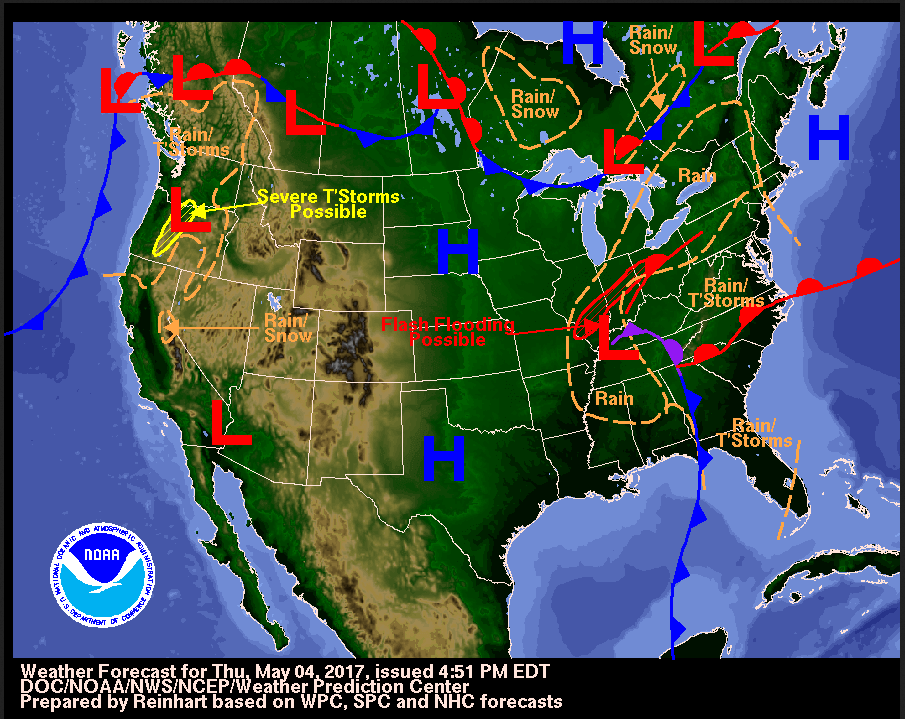
Meteorologists at the National Weather Service utilise information from ground stations and weather satellites to make these maps. Words like "pelting" and "snow" are pretty obvious, but what exactly do the symbols on a weather map tell you lot about the weather? Utilize our handy smashing guide below to detect out!
High and Low Force per unit area Areas

Earth's atmosphere is a jacket of gases that surrounds the planet. Although information technology seems like these gases could easily float abroad into infinite, gravity is constantly pulling the atmosphere toward Earth's surface. The strength with which our atmosphere pushes down on a specific location on Globe is called atmospheric force per unit area.
Atmospheric pressure is mainly dependent on two things: the weight of the atmosphere in a specific location and the temperature of the air. If you're at a low summit—such as in a valley—there is a lot of temper to a higher place you and the weight is very heavy. That ways that you experience higher atmospheric pressure at lower elevations and lower atmospheric pressure in higher elevations.

When y'all're at a low elevation, you experience high atmospheric pressure considering more of the atmosphere is pushing down on y'all.
Warm air can also crusade the atmospheric force per unit area to rise. When the air is warm, gas molecules move effectually quickly in the air pushing out on the area around them. This causes high atmospheric pressure level. In cold air the gas molecules tedious down, causing low atmospheric pressure level.
H2o vapor in the temper tin also modify the atmospheric pressure. Very moist air that has lots of h2o vapor is actually lighter and less dumbo than dry air. This is because water molecules are lighter than molecules of nitrogen or oxygen—the most abundant gases in our atmosphere. So, very moist air in the atmosphere can lead to depression atmospheric pressure and very dry air can pb to high atmospheric pressure level.
Atmospheric pressure is measured with an instrument on the basis called a barometer, and these measurements are nerveless at many locations across the U.S. past the National Conditions Service. On atmospheric condition maps, these readings are represented equally a blue "H" for high pressure or a red "L" for low force per unit area.
What it Ways on the Weather Map
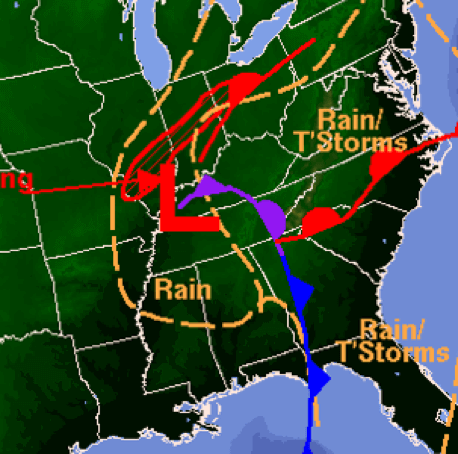
Low pressure systems—like this one in the Tennessee valley—can cause the formation of clouds and storms.
A loftier pressure system is a dense air mass that is ordinarily cooler and drier than the surrounding air. A low pressure arrangement is a less dense air mass that is usually wetter and warmer than the surrounding air.
In full general, areas that feel high atmospheric pressure also experience fair conditions. Low pressure systems can cause the germination of clouds and storms. Air commonly flows from areas of loftier pressure level to areas of low pressure level.
High and Depression Pressure Systems: From Space
From high above World, satellites such as GOES-16 continue an eye on the weather brought past low pressure systems. The ruby "L" on the map above indicates a low pressure system in the Tennessee Valley region. In the video below from GOES-16, you tin see what that same low force per unit area system looks like from a weather condition satellite.
Cold Fronts and Warm Fronts

A warm front end is the transition area where a mass of warm air moves to replace a mass of cold air. On a weather map, a warm front is normally drawn using a solid ruddy line with one-half circles pointing in the direction of the cold air that will be replaced. Warm fronts usually movement from southwest to northeast. A warm forepart can initially bring some rain, followed by clear skies and warm temperatures.

A common cold front is the transition area where a mass of common cold air moves in to supersede a mass of warm air. On a weather condition map, a cold front end is usually drawn using a solid blue line with triangles pointing in the direction of the warm air that will be replaced. Cold fronts typically move from northwest to southeast. A cold front can bring common cold temperatures, torrential rains and high wind speeds.

A stationary front happens when a cold front and a warm front see up, but neither moves out of the mode. On a weather map, a stationary front is unremarkably drawn using alternating cold forepart and warm front symbols. Stationary fronts bring long rainy periods that stay in one spot.

Cold fronts move faster than warm fronts, and sometimes a common cold forepart catches upwardly to a warm front. When this happens, information technology's chosen an occluded front. Occluded fronts are drawn as a solid purple line with half circles and triangles pointing in the direction that the front is moving. An occluded front usually brings dry air.
Common cold Fronts and Warm Fronts: From Space
GOES-xvi and other weather condition satellites are also on the lookout man for cold fronts and warm fronts and the weather they produce. Beneath, you can encounter the comparing of a cold front on a forecast map and a cold forepart in a satellite image.
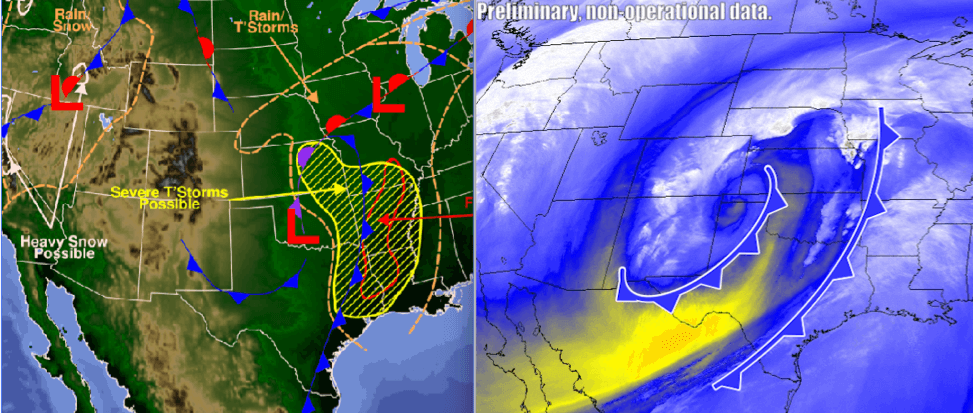
On the left is a National Weather Service forecast map from March 24, 2017. The forecast map shows two cold fronts moving southeast over Texas. On the right is an actual GOES-16 image of atmospheric water vapor from the same afternoon.
Weather Satellites
Information from weather condition satellites, such as the GOES-R series and JPSS will help improve our agreement of Earth's weather.
For instance, the GOES-R series provides information about atmospheric water vapor and cloud height correct now. This tin help meteorologists monitor and rails severe weather events, such equally storms and hurricanes every bit they happen. JPSS satellites survey the entire planet and continuously provide global atmospheric temperature and water vapor data. This information is needed to create reliable weather condition forecasts upwards to seven days in accelerate!
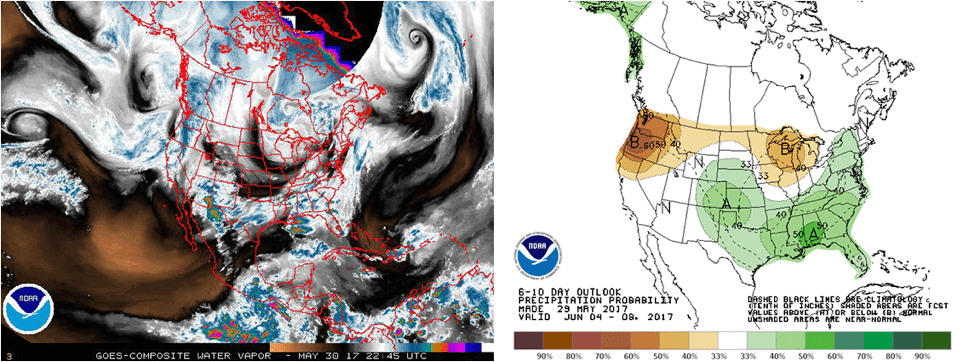
On the left is an image of water vapor captured by GOES satellites on May 30, 2017. GOES satellites, such every bit GOES-16, continue an eye on current weather. On the correct is a forecast map predicting precipitation 6—10 days in advance. Polar orbiting satellites—such as JPSS—provide an outlook of conditions events up to seven days in the future.
JPSS and the GOES-R series work together for weather applications. JPSS is critical for getting fix for severe weather events, while GOES-R monitors severe weather condition as it unfolds for existent-time warnings.
Source: https://scijinks.gov/weather-map/
0 Response to "Once Again Referring to the Surface Analysis Chart What Is the Pressure Near Points B and D"
Post a Comment